Posts

What Are Sharks Aware Of?

Image
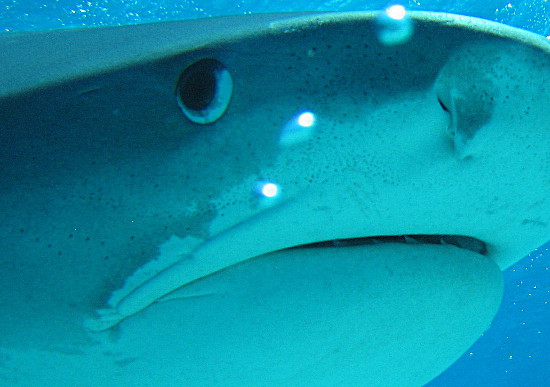
More and more divers are meeting sharks for the first time, and wondering, “What do they see when they pass, gazing at us gazing at them?” Sharks have a very different set of senses than we do, yet the eye-sight of the free swimming species is good, so passing sharks who have approached to look at you, are really seeing you. But you may have the impression that they are using senses other than their eyes most often, and indeed, apart from our shared good eye-sight, it is impossible for us to imagine how sharks experience their liquid realm. Sound and vibration are very important to them. Sound travels far in water, spreading out in a uniform spherical pattern, and sharks hear well. They are particularly sensitive to low-frequency vibrations, such as those caused by movement in the water, and crashing waves. And they can detect pressure waves with the sense organ called the lateral line. The lateral line is found in fish, sharks, and some amphibians, and is made up of a series of r...

Extinction Soup

Image
Extinction Soup is the inspired name of a new, dramatic film on the shark finning crisis, which Hawaiian film maker, shark diver, and advocate, Stefanie Brendl is spearheading. Philip Waller is the writer, producer and director, Sidney Sherman is the producer, and Travis Aaron Wade is the co-producer. The film is expected to be released in early 2014. For more information, have a look at their site. http://www.indiegogo.com/projects/extinction-soup All support is much appreciated, and there are lots of perks for those who donate something to this important project. Congratulations Stefanie! Good on you all for creating this fantastic work on behalf of sharks!

Pain in Fish : a review of the evidence

Image
Fisherman James D. Rose claims that fish can't feel pain. He has published a paper stating that the neocortex, the outer folded layer of the brain that is so highly developed in humans, is the seat of all higher mental functions, including consciousness of pain. Therefore, the neurological machinery required to feel pain is missing in a fish, and indeed, is present only in humans and apes. But, in focusing on a comparison of the human brain with the fish brain alone, Rose's article seems biased and anthropocentric. Rose did not give a reason for his assertion that consciousness depends, alone, on the neocortex. Nor did his argument take into account the straightforward evolution of the vertebrate brain. From fish to man, the brain has the same structures, arranged in the same way, with the exception only of the neocortex, which developed in mammals. Neurological studies have shown that the newly evolved neocortex of mammals took over certain higher functions, which were al...

Fish Are Animals Who Do Things

Image
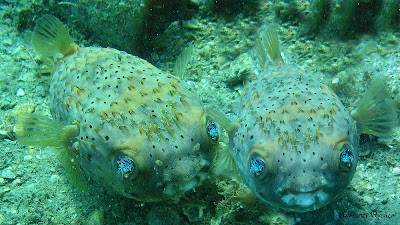
If you find it hard to believe that fish feel pain, consider this! Cognition—the ability to think—was an important factor in the establishment of whether fish could feel pain, and it happened that in the same year as Rose's article was published, Bshary, Wickler, and Fricke published a review of the findings on the cognitive capabilities of fish (Bshary et al 2002). Here are a few examples: Recognition of others as individuals has long been established in many varieties of fish, both visually and acoustically (Myrberg and Riggio 1985). It forms the first step towards complex social lives, in which cognition is often most evident. I documented relationships among reef sharks for years. They, too, relate to each other individually. Social learning is illustrated by the migrations of the surgeon fish ( Acathurus nigrofuscus) , described in detail by Arthur A. Myrberg Jr. in 1998. These fish leave their territories all over the lagoon, and travel in single file through paths ...

Keep the Secrets of the Sea

Image
In January an in-depth study of the current depletion of sharks was published (Worm et al 2013). It revealed that the numbers of sharks killed for shark fin soup are not falling, that no sharks have been saved, and that the ravenous market for the infamous party soup continues to be fed, in spite of the increase in support for shark protection that has come in the last decade. A review of the way our society treats sharks reveals almost no segment in which they are respected, with the exception of certain researchers, divers and veterinarians. Their fins are taken for soup by the Asians, they are vilified by Shark Week in the west, they are wrestled and stabbed by scientists for a few minutes of glory as a he-man “shark fighter” on National Geographic or the ill-termed “Discovery Channel,” and they are fished as sea monsters by “sportsmen.” Television with its monster shows has unleashed an out pouring of hatred that has allowed them to be massacred in full view with almost no p...

The Value of Ethology

Image
While I preferred to study sharks directly through underwater observation, shark researchers often choose tagging methods which allow them to gain certain types of data remotely. The advantages of this method are evident, but the loss of contact with the animal itself results in a dramatically impoverished understanding of them. A good example is the recently announced study concluding that grey reef sharks swim at different depths depending on the phase of the moon. (link here) No mention of the effect of the moon on the sharks' general behaviour or subjective states was mentioned. The trouble is that it was not just ignored, it was not even seen. So the study is a dismal, one dimensional report, that might as well refer to robots, for all the understanding it provides of sharks. The hype with which the “finding” was announced also failed to acknowledge the many others over time who have noted that sharks, like other animals, use both of this planet's sources of...

STOP Shark Fins at the B C Coast : A Petition!

Image
Sign now :  http://www.thepetitionsite.com/681/363/318/block-shark-fins-at-the-bc-coast/ Given the decision by Canada's federal government to support the shark finning business by defeating Bill C-380, British Columbia must act at once to block shark fins from entering Canada via its west coast. California, Oregon, and Washington states have already made it illegal to trade, possess, or distribute shark fins, leaving British Columbia as the only remaining entry point for shark fins on the west coast of North America. Across the Pacific Ocean the sharks inhabiting vast archipelagoes of islands are being massacred to supply the voracious market for the costly party soup across North America. By halting this province’s contribution to the crisis, we will broadcast the strong message that British Columbia refuses to play a role in driving so many species of sharks to extinction. The facts : Shark fin soup is a vanity dish. The monetary value is so high that...