Posts

Showing posts with the label shark ethology

Raising Shark Awareness

Image
My personal campaign to raise shark awareness began when the entire community of hundreds of sharks that I was studying, as animals and individuals, were finned for shark fin soup. Sharks (and fish) had turned out to be more interesting, more varied, and in many cases, more beautiful, than the North American wildlife I had known. They were just as intelligent, and far more responsive to me. They were definitely more alert, and made decisions more quickly, than people. Sharks were the first wild animals I had met that came to me instead of fleeing, and though I had fed the birds all my life, they never fluttered down around my shoulders when I went outside, or alighted in my hands to be stroked. But fish did. So it is especially sad to see how these remarkable submarine animals are considered and treated in our society, as being low, cold and not even capable of suffering pain. That is why I have been on a personal campaign ever since to improve public aw...

Sharks Enjoy Divers as Divers Enjoy Sharks!

Image
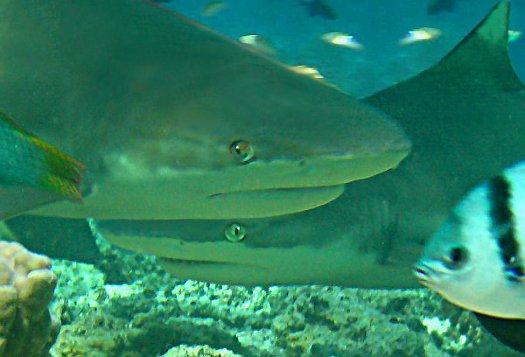
Sharks are interested in others, and their spontaneous gestures toward divers show their curiosity toward other members of their submarine community, including divers who show interest in them. The interest is returned. Thus it is possible through photos to capture the eye to eye gaze of these mysterious creatures of the deep, when for just few moments of their day, they meet us. Recognition of others as individuals has long been established in fish and sharks, as in other social species. As well as knowing others, sharks demonstrate by their actions that they recognize themselves as being separate from others and observable. To this degree they are self aware . The photo shows one of my shark companions coming to greet me when she found me in the lagoon. She looks at me with first one eye and then the other as she approaches with her gently undulating movement. She nearly touches my face with hers, then turns to swim away at an angle over my shou...

Blackfin Reef Shark Evacuation from Moorea Island, 2002

Image
Blackfin reef sharks ( Carcharhinus melanopterus) reside in the lagoons and on the outer slope of the barrier reefs of Moorea Island. This coral habitat is shallow enough to facilitate underwater observation of the species. Regular observation at different sites centering in the Vaihapu region (Galzin and Pointer 1985) yielded a large amount of data on their movements, ethology, and social biology between 1999 and 2007 (Porcher 2005). In 2002, all blackfin reef sharks under observation, not only by the author but also by the dive clubs holding shark dives, left the north shore of the island for a period of ten days to two weeks. This event suggests an unknown pattern or influence at work. With the surprising new information from Johann Mourier, that these sharks   easily travel between islands, I'm re-posting my account of their unexplained and unprecedented disappearance from Moorea Island in late July, 2002. Johann began studying the same sharks that I observed, u...

A Film by Shanon Sparks

Image
While speaking on shark cognition during a tour in Florida, I was called the Jane Goodall of sharks because of the close bonds I formed with the local sharks in Tahiti. Accepted into their community, I documented their intimate behavior over many years before they were finned by a company from Singapore, for the shark fin soup market. So when  Shanon Sparks, who interviewed me for her film about shark intelligence, made a video clip about my book, she entitled it "The Jane Goodall of Sharks"

Thoughtful Sharks : Knowing Others as Individuals

Image
In Tahiti, I observed the reef sharks inhabiting the nearby lagoon. They soon accepted me into their community, and by noting the behaviour of each individual in a variety of situations over a period of many years, I found an unknown dimension of their lives, never before observed or documented. This included much evidence that the sharks were using cognition, or thinking, in their daily activities, rather than the automatic stimulus/response reactions that had been assumed to control their behaviour. To illustrate the difference between automatic behaviour and cognition, consider a calculation. The act of calculating, which is so easily and swiftly accomplished by computers, is analogous to automatic behaviour. But understanding the reason for the computation requires cognition, which the computer will never achieve. Various domains of science use different definitions of cognition, but for me as an ethologist, the most straightforward definition is : the purposeful manipulat...